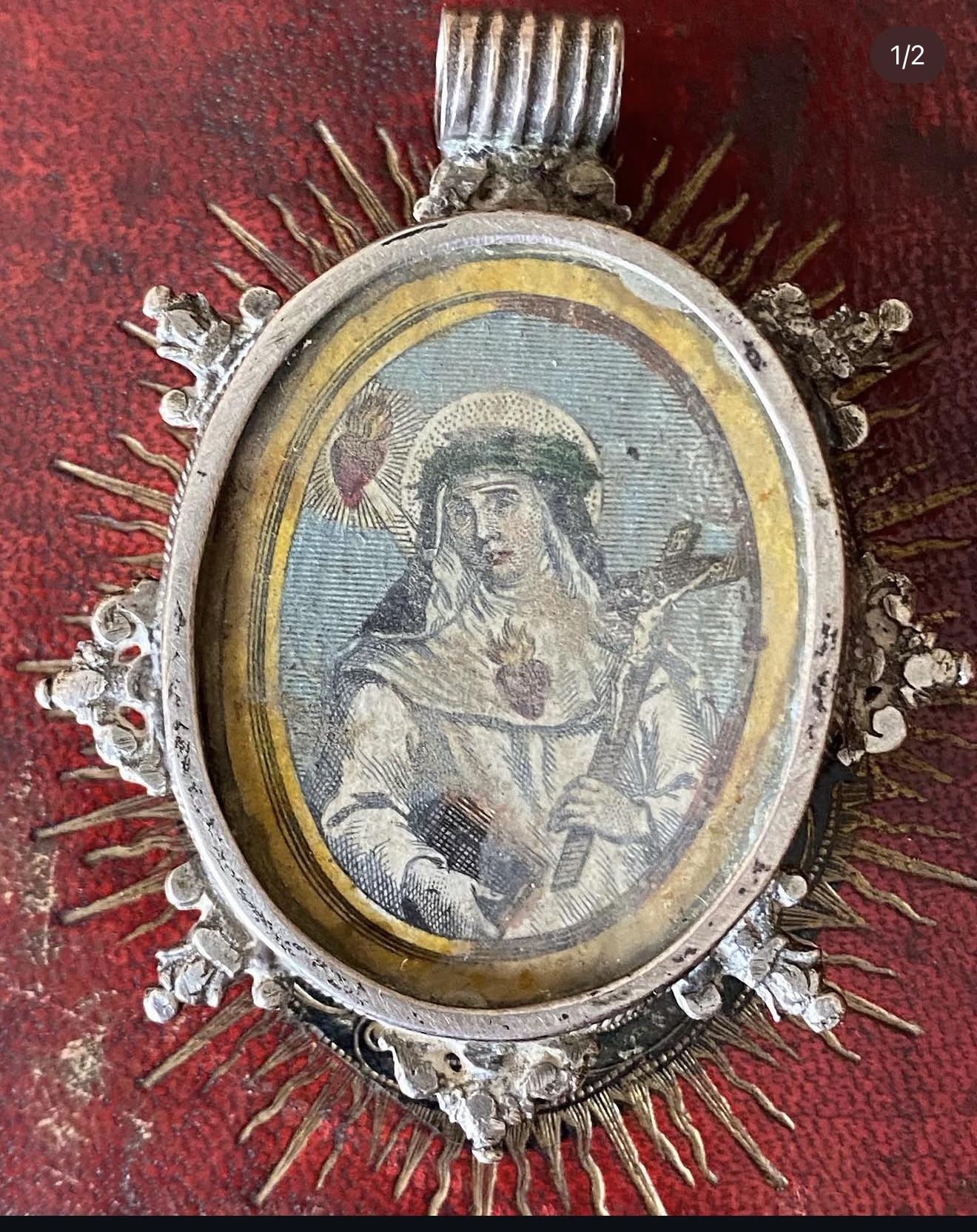
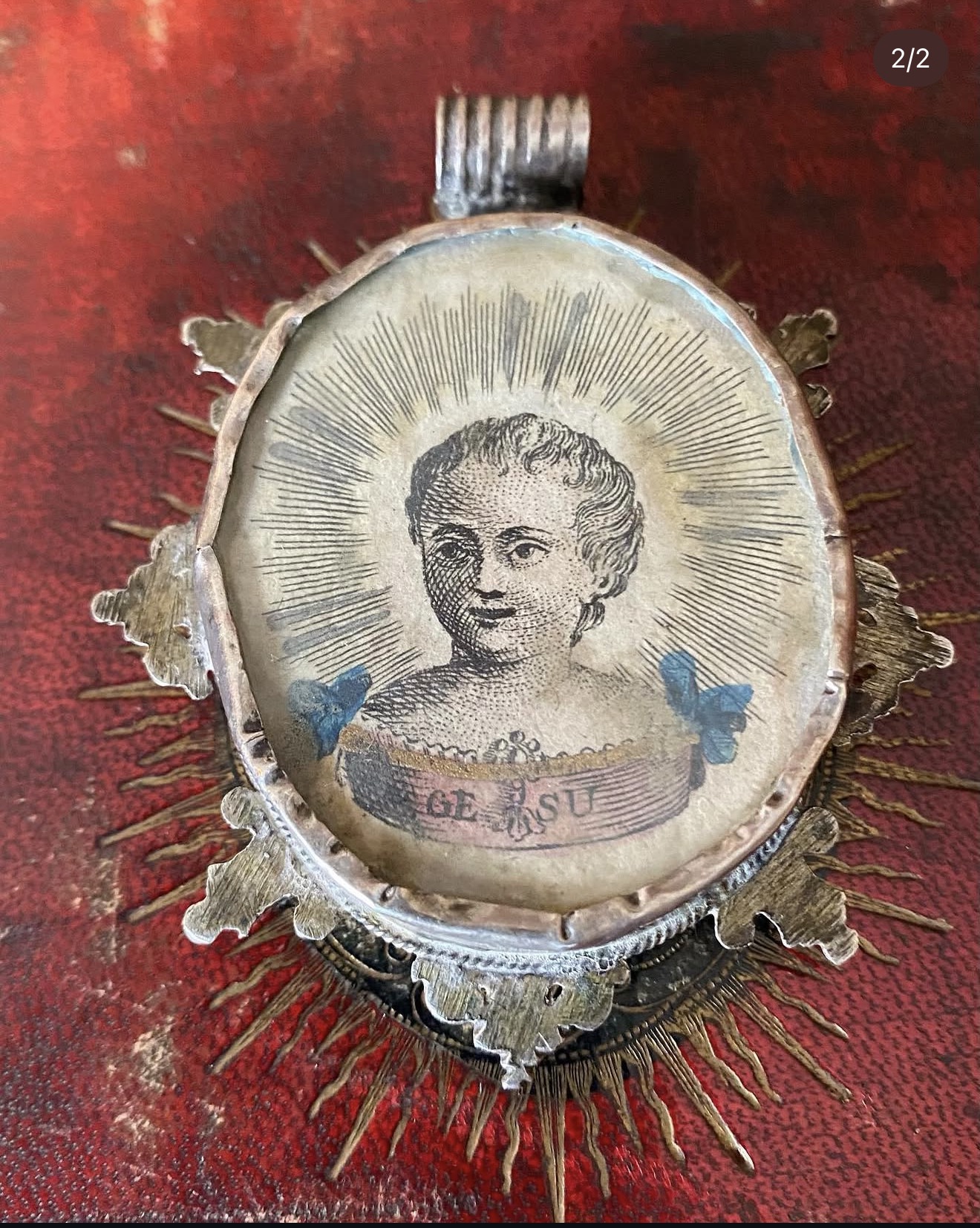
At first glance, it is a small piece of Catholic devotional jewelry. Look closer, and it becomes something far more absorbing: two miniature sacred images, enclosed behind transparent covers, framed in elaborate metalwork and apparently sealed together.
The Turner House Collection acquired this double-sided pendant from Vision and Vasari in 2023. The dealer described it as an eighteenth-century Catholic reliquary. That description offers a useful starting point, but the pendant has questions of its own to answer.
Two images, one object
One face shows a veiled female saint. A crucifix, a thorn-like crown and imagery resembling a flaming heart are among the details that may help identify her. Saint Veronica Giuliani and Saint Catherine of Siena have both emerged as possible subjects in our comparisons with Catholic devotional prints. Neither identification is settled.
On the other face appears a youthful, haloed figure, probably the Christ Child. A small banner seems to carry the name GESÙ, or Jesus. The images are finely worked and appear to include printed lines and selective hand coloring. Gold-colored highlights are particularly striking on the banner and around the oval border of the saint’s portrait.
The mystery of the seal
The metal frame has a suspension loop and ornamental projections around its edge. The pendant appears closed around its entire perimeter, with no obvious means of opening it. Traces of a pale substance remain along the central join, possibly connected with an earlier sealing or assembly process.
That detail matters. A reliquary can enclose a relic, but a devotional pendant can also preserve sacred images without containing relic material. Nothing visible in the pendant currently establishes that a relic is present. Opening it merely to satisfy curiosity could damage the original construction and erase evidence of how it was made.
Following the prints
The images may offer the best route toward a date and place of manufacture. Small Catholic prints circulated widely, and the same devotional compositions could be copied, recolored and placed in different settings. Comparisons so far point toward Italian devotional imagery of the later eighteenth or early nineteenth century, although the exact print sources have not yet been identified.
The next step is to find the printed compositions from which these miniature portraits were taken. A close match could reveal a saint’s identity, a publisher, or a date. The metal setting may have a separate history, since images and cases were not necessarily made at the same time.
Comparative Examples: Images, Settings, and Construction
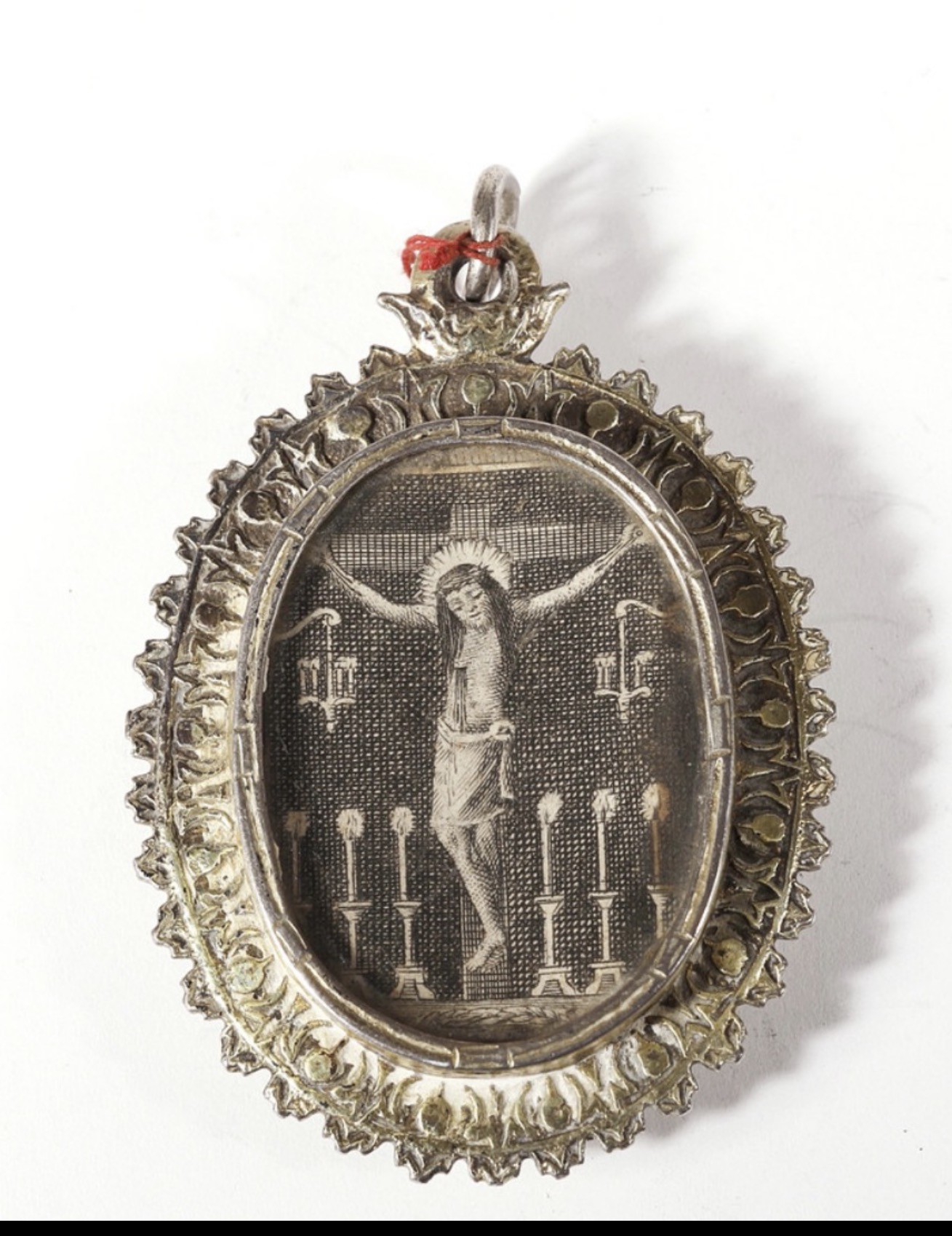
Two related devotional pendants provide useful points of comparison. Neither reproduces the Turner House example exactly, but each shows how small religious images could be incorporated into elaborate wearable settings.
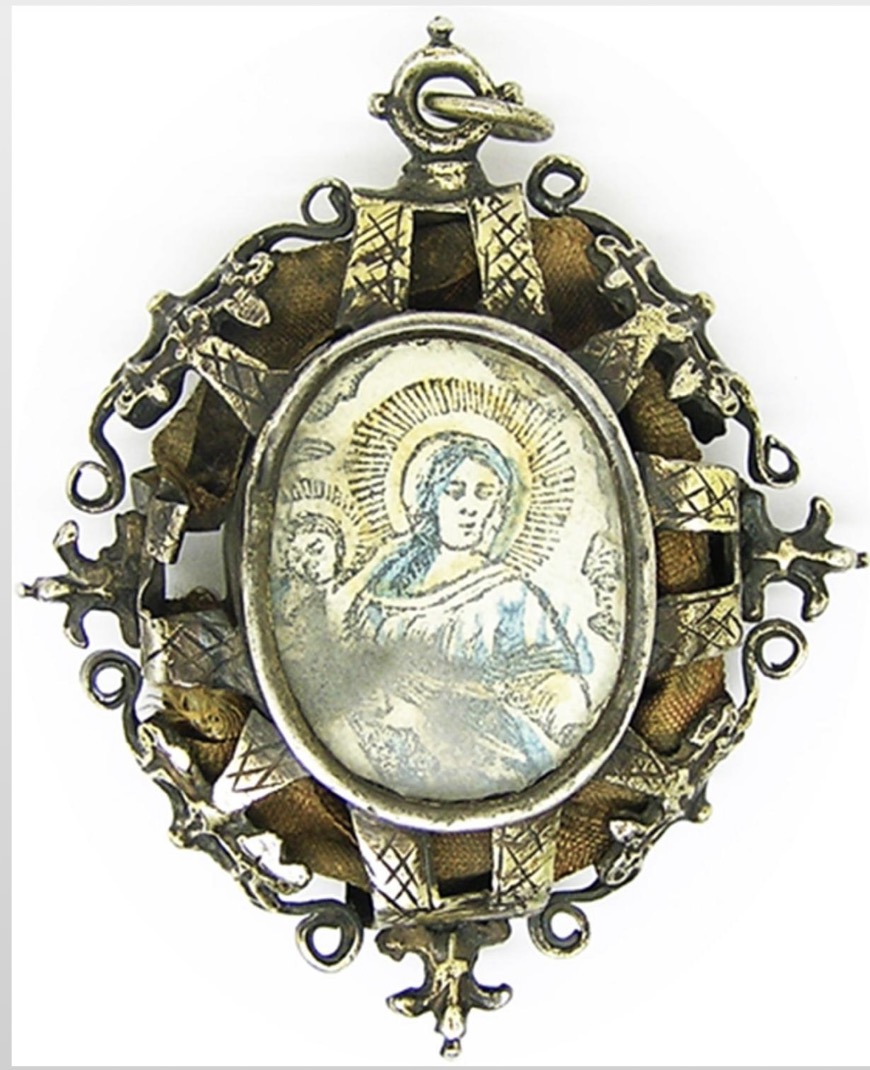
The first comparator combines a small, colored religious image with an oval metal bezel and a striking openwork surround. Its suspension ring and pierced decorative elements make it especially useful for studying how such pendants were assembled and worn. The Turner House pendant has a different outer profile, including fine radiating elements, but both demonstrate the importance of the setting as part of the devotional object.
The second comparator places a finely engraved religious image within a closely fitted oval frame and a more continuous ornamental border. Its fine printed lines invite comparison with the engraved images enclosed in the Turner House pendant. The subject, however, is different, and visual resemblance alone cannot establish a common workshop or date.
These comparisons suggest a productive line of inquiry: were the printed devotional images sold separately and later mounted by metalworkers, or were image and setting produced for one another? A closer study of the rims, attachment points and printed sources may help answer that question.
The pleasure of this object lies in its concentration of detail. A few centimeters of metal, glass and paper bring together the history of private devotion, the trade in religious prints and the skill of the people who assembled them. We are still learning how its two images came to be joined, and what they meant to the person who once wore it.