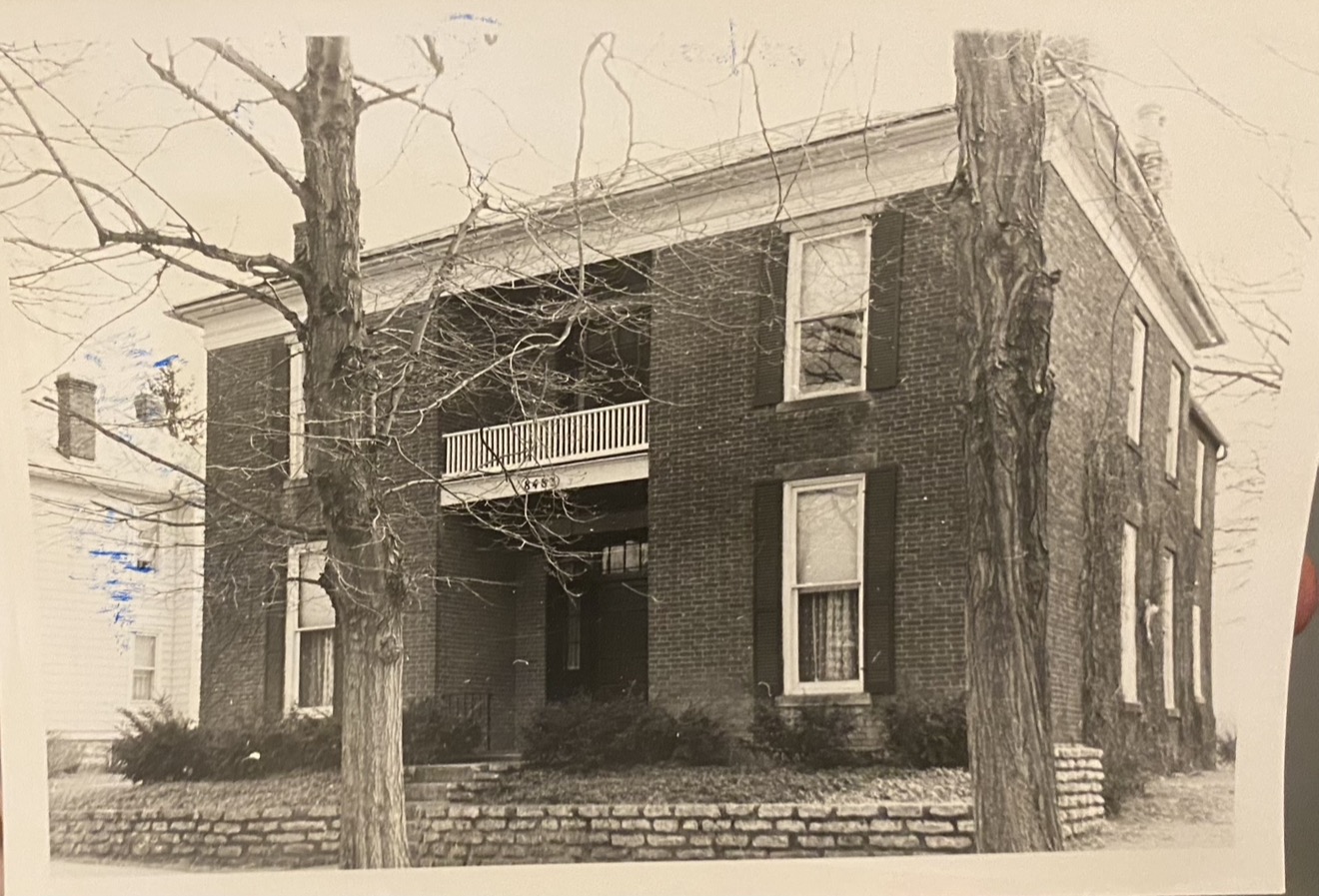
A building is an object on a different scale.
The paper trail begins with early land deeds. The building itself offers another kind of record: walnut woodwork, adjoining parlors, a soaring staircase and objects recovered from concealed spaces. Together, these sources let us follow the people who shaped the house and the village around it.
Before the House
The house stands on Original Lot 6, part of the early settlement that became Rushville. A deed dated May 10, 1815 shows Joseph and Elizabeth Turner conveying a group of lots, including Lot 6, to Henry Hall, while the community was still described as the Town of Clinton. Hall and his wife Mary conveyed the holding to John Kerlin in 1816. Subsequent transfers involved Robert C. Thompson and, after a trustee’s auction on March 2, 1831, William Crist.
These deeds trace the land, not necessarily the present building. None establishes that the surviving brick house existed before Dr. Peter F. Turner acquired the parcel. Nor has a family connection been proved between Joseph Turner, the 1815 grantor, and the Scottish-born physician whose name the house bears.
Dr. Peter F. Turner and His Household
Dr. Peter F. Turner, born in Scotland around 1819, was practicing medicine in the Rushville area by the early 1840s. A later confirmatory deed records his purchase of Lot 6 from William and Sarah Crist for $400 on or about May 1, 1842. The substantial two-story brick house became both his family residence and his medical practice, with professional rooms at the front and larger family rooms and parlors behind them.
The residence witnessed the complexities of the Turner family’s life. Peter’s first wife, Mary Ann, died in December 1847, leaving young children. He married Huldah Jane Grant in November 1848. The census and cemetery records trace children of both marriages, alongside repeated childhood bereavement. Later daughters Estilla and Leota carried the family story beyond Ohio into Iowa.
Turner prospered as a physician and landowner. He served during the Civil War in the 17th Ohio Infantry’s three-month enlistment in 1861, as recorded in the surviving veterans’ schedule. The available records do not indicate that he saw combat, but he was a Civil War veteran. A notice in the Lancaster Gazette on June 18, 1868 offered his “elegant Brick Dwelling house in Rushville” for sale as he prepared to move to Zanesville. The advertisement is one of the most valuable contemporary descriptions of the property’s existence and status.
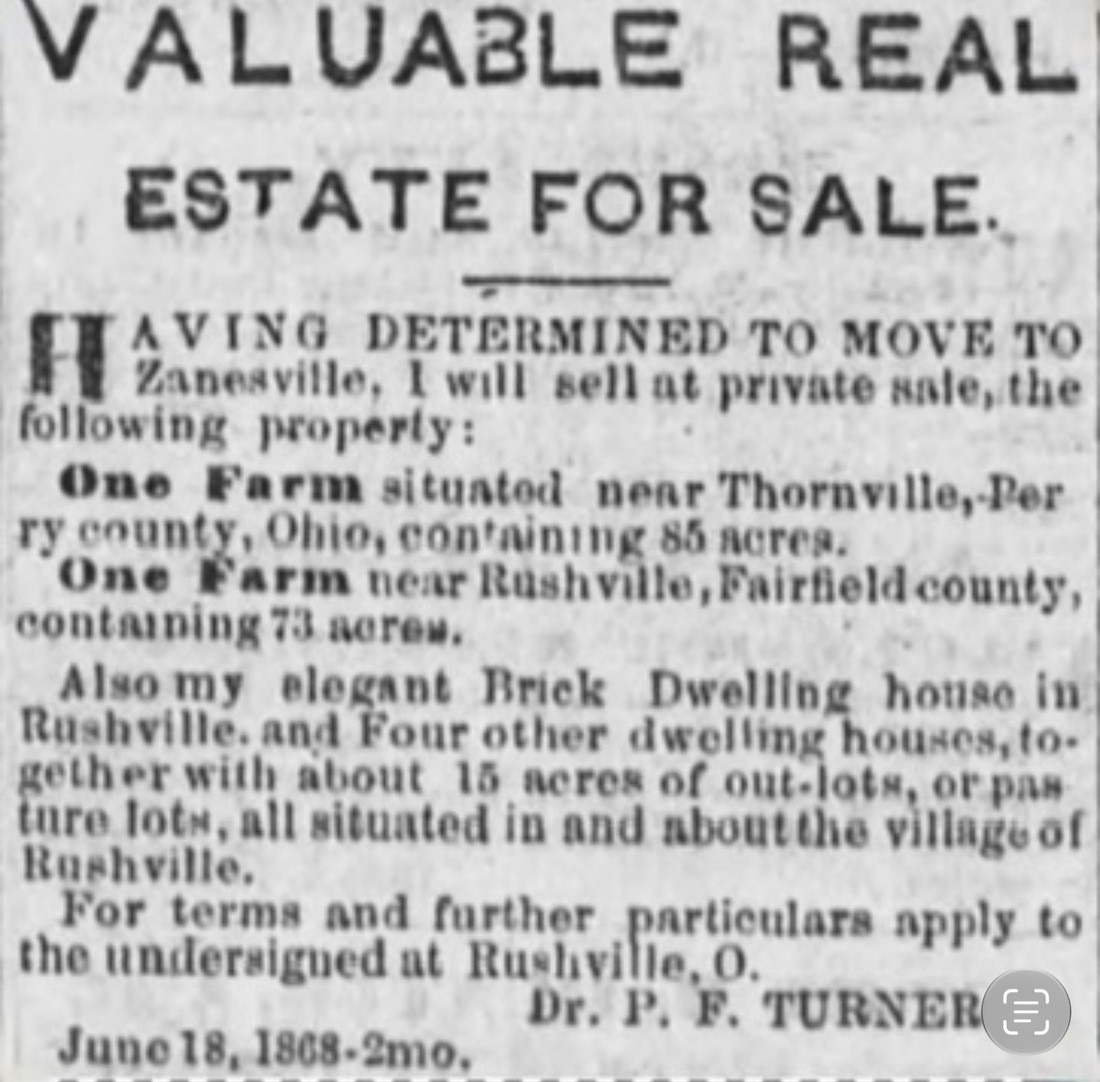
The next chapter of Turner’s biography lies in records of his Scottish origins, medical training and later life. Those records may yet tell us more about the man who gave the house its name.
The Kerr Family
On February 15, 1869, Peter F. Turner and his wife conveyed Lot 6, with approximately fifteen additional acres, to Alexander Kerr for $3,000. This recorded deed supplies a firm foundation for the house’s next chapter.
Alexander and Sarah Huston Kerr belonged to a family deeply entwined with Rushville’s history. Their children included C. K., Robert W., David, and Elizabeth. Two sons were remembered as operating a dry-goods business in the village. According to family accounts preserved by Samuel B. Hyde, Robert W. Kerr later lived in the house for many years.
Elizabeth Kerr married Joseph K. Hyde and became the mother of local historian Samuel B. Hyde, whose recollections of Rushville preserve stories of the Kerr household and its neighbors. Hyde’s family relationship makes his account especially valuable, although some remembered dates differ from the deeds and must be evaluated independently.
The Love Family
Samuel Hyde recalled that William Love and his wife Isabella purchased the property around 1912. Their son Frank Love and his wife Irene Henderson Love, remembered locally as a teacher, became closely associated with the house. Hyde’s reminiscences help reconstruct the family’s presence, but the precise sequence of Love-family conveyances has not yet been fully checked against recorded deeds.
The Turner House received a feature of its own in the February 11, 1964 edition of the Lancaster Eagle-Gazette. Writing for the newspaper’s Historic Homes series, Marie Heyer titled her article “Designer’s Whim Marks 1830s Turner-Love Home, Rushville.” Published during Frank and Irene Love’s years in the house, it preserved stories of the Turner family and a detailed picture of the building’s remarkable interior. Readers learned of its black-walnut woodwork, adjoining parlors, and extraordinarily tall staircase, whose stairwell was said to require a strip of wallpaper some twenty-two feet long. The feature remains an important historical portrait of the house as it was remembered and lived in during the twentieth century.
Available ownership history indicates the Love family remained connected to the property until 2019. The full twentieth-century deed chain remains a research priority. Its continuing occupation through generations helped preserve the building as a lived-in home rather than a frozen architectural specimen.
The Fabric of the House
The Turner House is a substantial two-story brick residence. Its symmetrical frontage, recessed entrance, second-story balcony, and restrained exterior details retain the character of the late Federal and early Greek Revival transition. Across Main Street stood another prominent brick landmark, the house of Dr. Simon Hyde. Later local recollections cast the Turner residence as a more ambitious counterpart to its neighbor, although the precise circumstances of its design are not documented.
The interior preserves extensive black-walnut finish and the folding doors that join the two principal parlors. Accounts from 1964 noted the unusual height of its staircase, multiple fireplaces, and smaller front rooms associated with Turner’s medical practice. The detached summer kitchen survives at the rear. Some timbers may have been reused from an earlier structure, but their original context and the outbuilding’s date are not yet established.
Objects recovered from the building
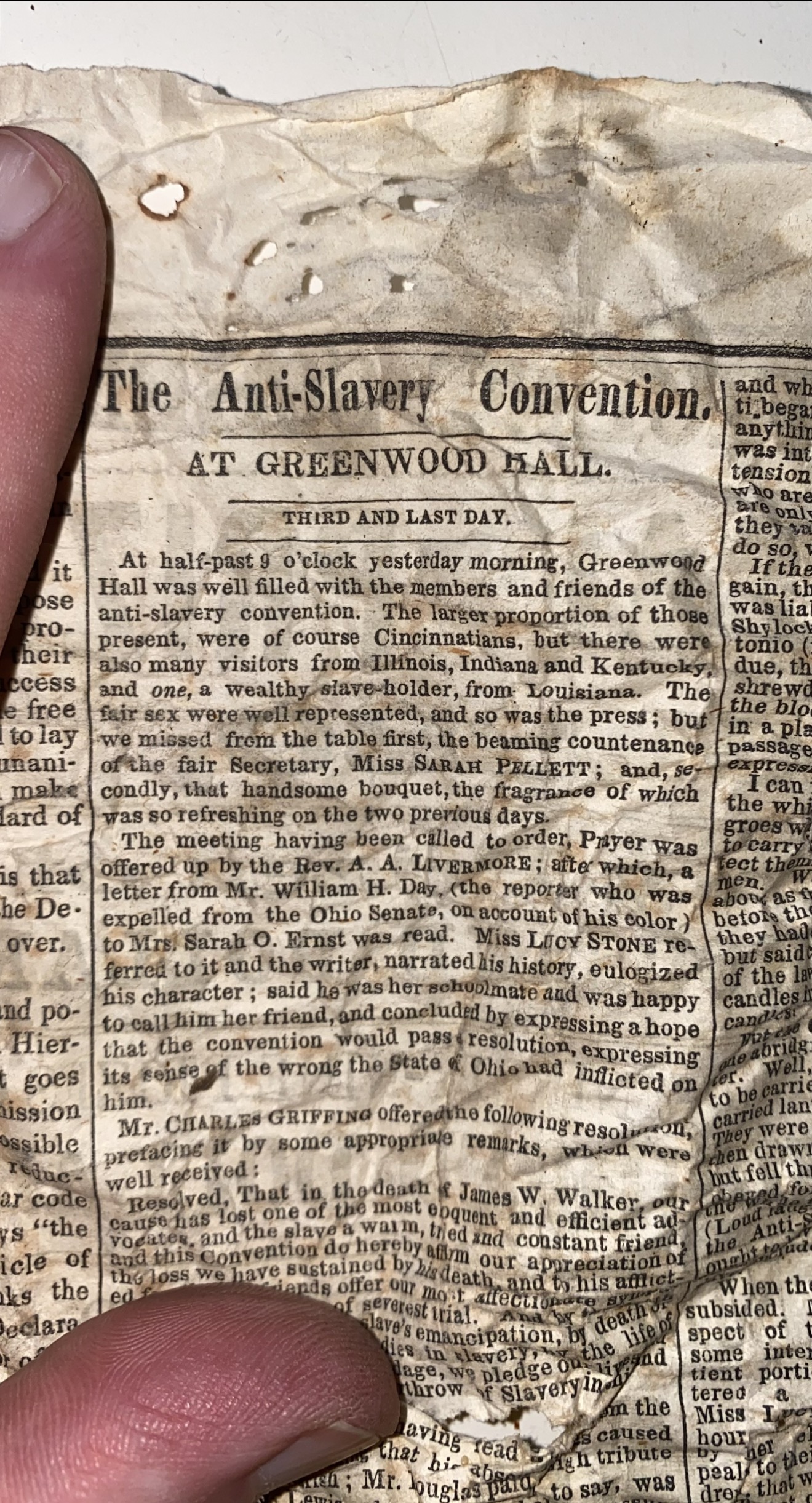
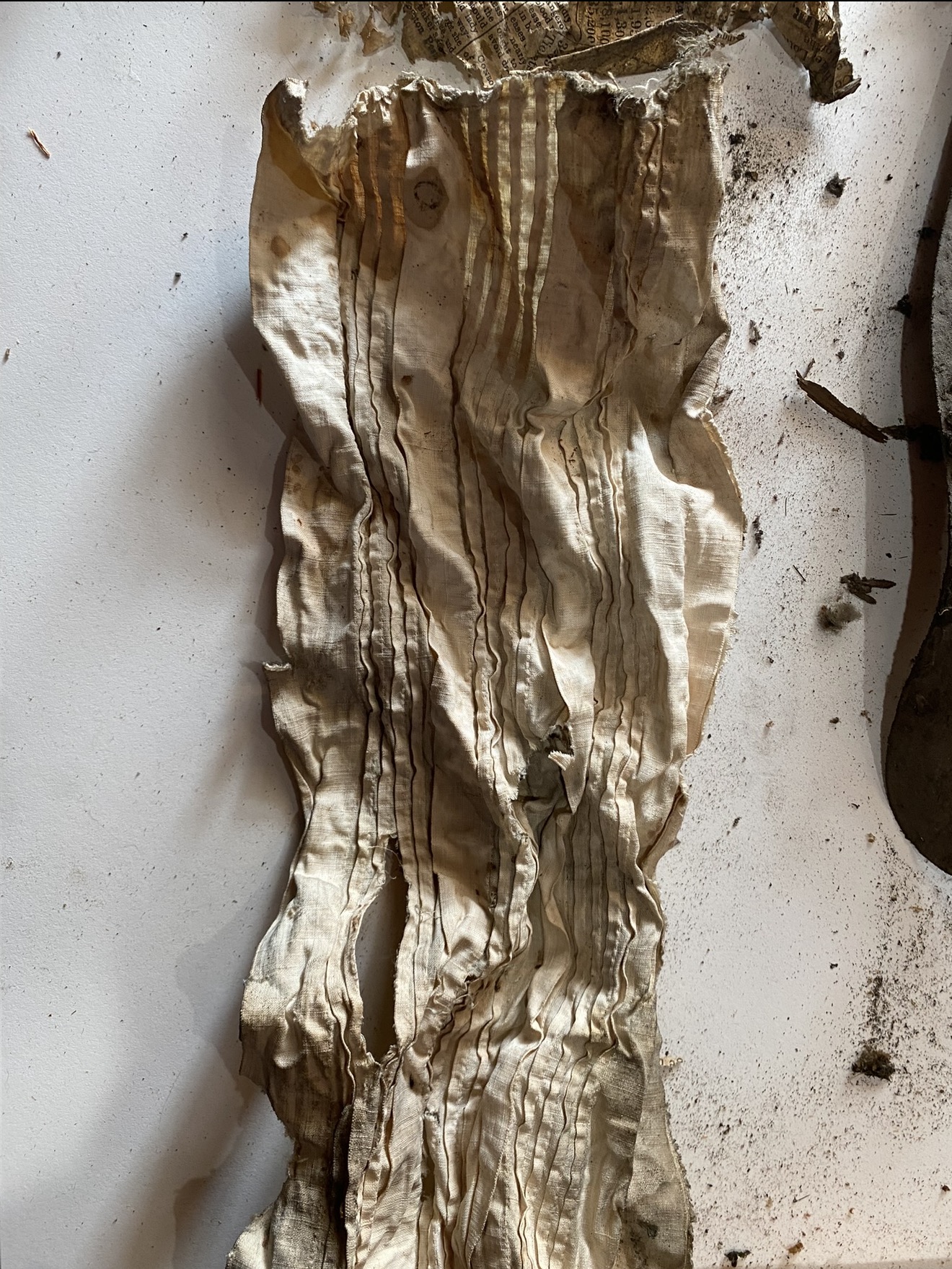
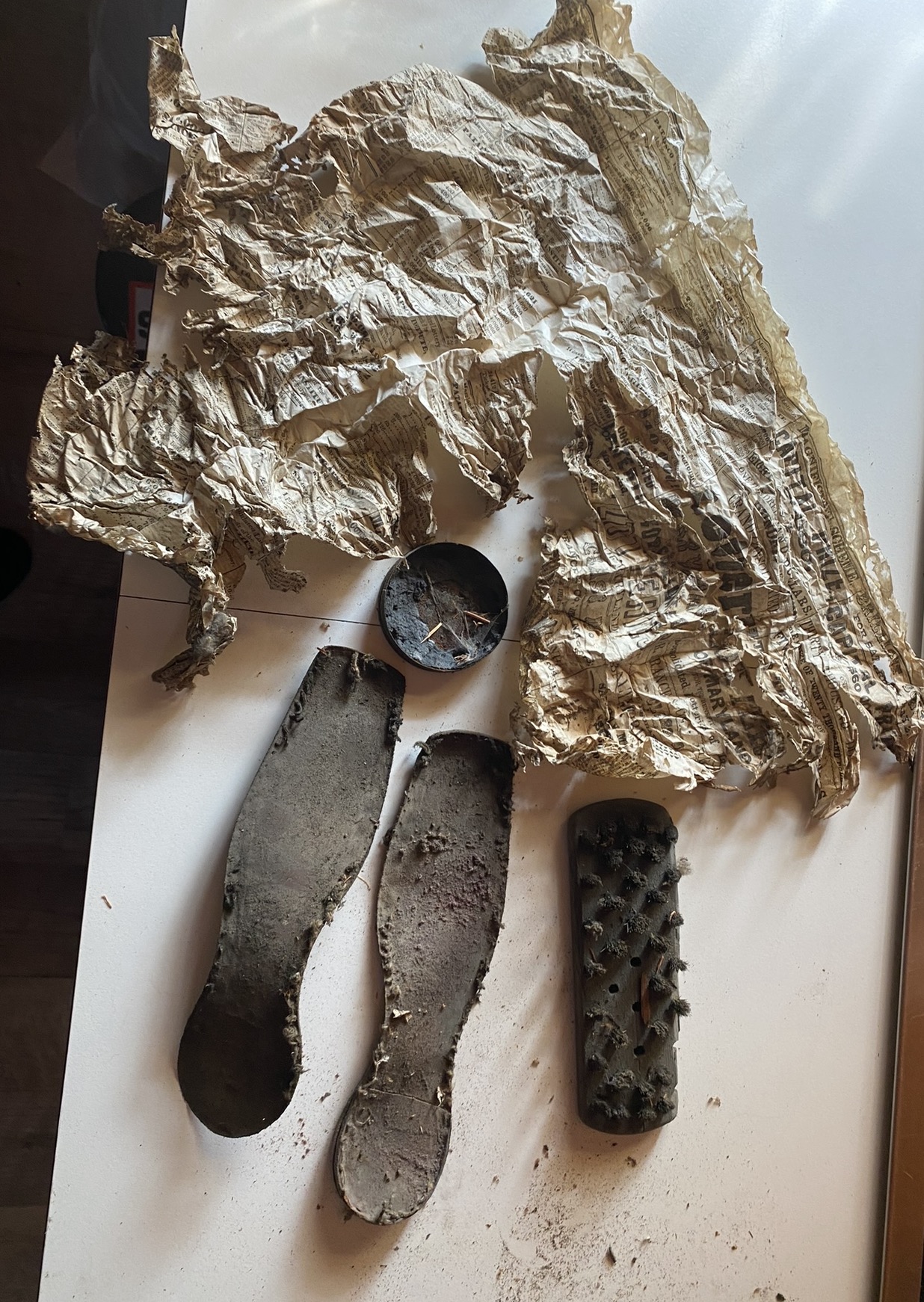
In 2022, investigation of a concealed stair cavity revealed fragments of an 1854 newspaper, textiles, a pair of shoe soles, a brush, and a small tin. Their survival in the building is remarkable; whether they were deliberately hidden, moved during repairs, or gathered by rodents is still uncertain.
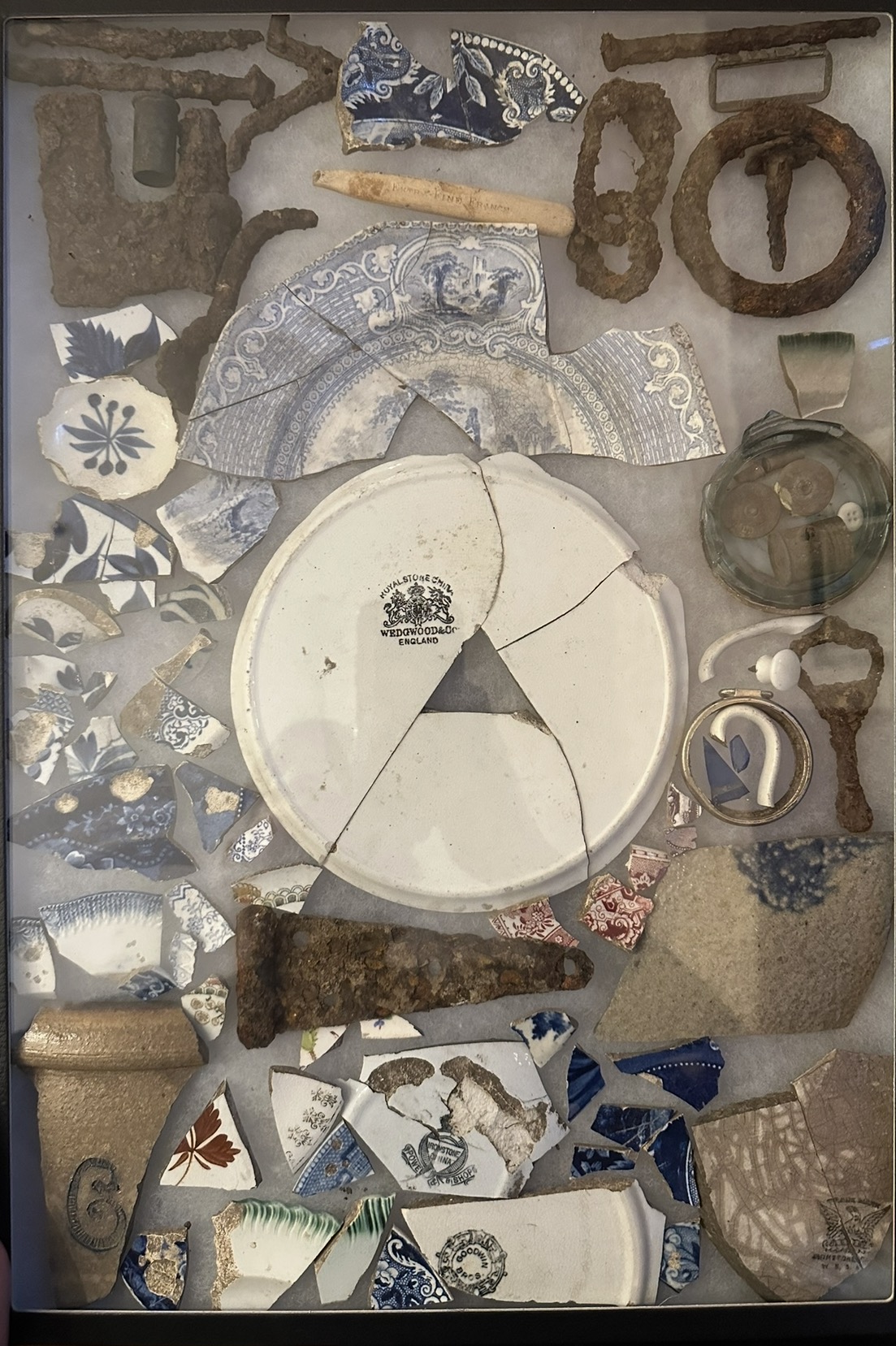
Finds from the grounds have also been recorded in the Ohio Archaeological Inventory as site 33-FA3228. Historic ceramics, glass, metal fittings, buttons, nails, and related objects offer evidence of changing household practices. Some deposits may represent multiple periods of occupation; individual finds should not automatically be assigned to a particular family.
What the House Remembers
Among the stories attached to the Turner House is its possible role in Rushville’s Underground Railroad network. A 1949 letter from Clara G. Mark to historian Wilbur H. Siebert preserved a recollection attributed to Kingsbury Hyde, who had spoken in 1907 of people seeking freedom and of a large brick house opposite the Hyde residence. The description is consistent with the Turner House; Siebert subsequently published the tradition in The Mysteries of Ohio’s Underground Railroads (1951).
This is specific, named oral-history evidence, not a contemporary record of individual freedom seekers staying in the building. The interpretation deserves further investigation, but no currently identified antebellum document establishes particular visitors, hiding places, or events inside the Turner House. Nor should the household objects discovered within its walls be assigned to Underground Railroad activity without independent evidence.
The Ghost of the Turner House
The house had another reputation in Rushville, one that still gives its history an air of mystery. In her February 11, 1964 Lancaster Eagle-Gazette feature, Marie Heyer recalled Samuel B. Hyde’s memory of being frightened to pass the Turner House when he was a boy. The article also spoke of a ghost said to make frequent appearances there. Who, or what, people believed they had seen was not recorded. But the story survives as a remarkable piece of village folklore, attached to the brick house long before its present occupants began researching its past.
Explore Rushville and the Underground Railroad for the wider community history.
Stewardship and the Turner House Collection
The present owner, Matthew S. Schweitzer, acquired the house in February 2022 and began documenting its architecture, property records, and discoveries. The historical and archaeological material recovered from the building has become an essential part of the Turner House Collection, whose research program brings historical objects, printed sources, and surviving places into conversation.
The house itself is thus not simply where the Collection is housed. It is a collection object with a provenance, shaped by the Turner, Kerr, Love, and later households, preserving evidence in its fabric and accumulated material culture, and still capable of yielding new historical knowledge.
The Turner House remains a private residence. The research Collection is not currently open for unscheduled tours. Its long-term purpose is preservation, documentation, and original scholarship.
The Turner House Through Time
Behind the familiar brick façade lies a changing history of families, occupations, wartime service, village memories, and discoveries still being made. This timeline follows the house from the early deeds to the present day.
Before the House
- 1815The earliest deeds
Joseph and Elizabeth Turner convey several Rushville lots, including Lot 6, to Henry Hall, when the village is still called Clinton.
- 1816The Hall–Kerlin transfer
Henry and Mary Hall convey the property to John Kerlin, continuing the chain of title long before the surviving brick residence.
- 1831William Crist acquires Lot 6
Crist purchases the lot following a trustee’s auction. Eleven years later, he will sell it to Dr. Peter F. Turner.
The Turner Years
- 1842Dr. Peter F. Turner arrives
A later confirmatory deed records the physician’s purchase of Lot 6 from William and Sarah Crist for $400, on or about May 1.
- Early 1840sA brick house takes shape
The substantial residence is built for Dr. Turner, combining his family home with medical rooms facing the street.
- 1847Loss in the Turner family
Turner’s first wife, Mary Ann, dies in December. The family’s cemetery and census records preserve other losses during these years.
- 1848A second marriage
Dr. Turner marries Huldah Jane Grant in November, beginning a new chapter of the Turner household.
- 1854A newspaper survives
An issue dated May 1854, including a report on an anti-slavery convention, survives inside a stair cavity, where it will be rediscovered in 2022.
- 1861Civil War service
Dr. Turner serves in the 17th Ohio Infantry’s three-month enlistment and becomes a Civil War veteran.
- 1868An “elegant Brick Dwelling” for sale
Preparing to move to Zanesville, Turner advertises his Rushville house in the June 18 Lancaster Gazette. See the original advertisement.
The Kerr and Love Households
- 1869The Kerr family takes possession
On February 15, Turner and his wife sell Lot 6 and adjoining acreage to Alexander Kerr for $3,000. The property becomes closely connected with Alexander and Sarah Kerr’s family.
- Later 1800sThe Kerr family’s memories
Robert W. Kerr lives in the house for many years, according to family recollections. His nephew Samuel B. Hyde later preserves the family’s stories of Rushville.
- 1907An Underground Railroad recollection
Kingsbury Hyde recalls stories of people seeking freedom and a large brick house opposite the Hyde residence; that testimony is later preserved in writing.
- c. 1912The Love family era begins
William and Isabella Love are remembered as acquiring the house. Later, Frank and Irene Love make it their home.
- 1949A memory reaches the archives
Clara G. Mark writes to historian Wilbur H. Siebert, preserving the earlier Hyde-family recollection about Rushville’s Underground Railroad network.
- 1951The house enters Underground Railroad history
Siebert publishes the tradition of a large brick station opposite the Hyde home in The Mysteries of Ohio’s Underground Railroads.
- 1964A newspaper portrait, and a ghost story
Marie Heyer profiles the Turner–Love home in the February 11 Lancaster Eagle-Gazette, describing its architecture and recalling Samuel Hyde’s story of a frequently appearing ghost.
- 2019The close of the Love-family era
The Love family’s long association with the property ends, closing a chapter extending across much of the twentieth century.
The House as a Research Collection
- 2022A new owner and a hidden discovery
Matthew S. Schweitzer purchases the house in February. Work on the staircase later reveals an 1854 newspaper, pleated cloth, shoe components, a brush, and other household objects.
- 2024The grounds yield more evidence
Investigations of historic deposits in the grounds recover ceramics and everyday material, adding an archaeological dimension to the house’s story.
- 2026The Turner House Collection takes shape
The property’s archaeological finds are documented under Ohio Archaeological Inventory site 33-FA3228, while the house and its surviving records become a continuing focus of the Collection’s historical research.
The sequence draws on deeds, newspapers, family recollections, and the material record of the house. Individual dates and inherited stories are discussed in the sections above.